
Or: Why British Government Is Basically a Washing Machine Stuck on Spin Cycle
Every few years, a politician stands at a lectern, looks serious, and announces that power is going to be devolved.
This week it was Andy Burnham.
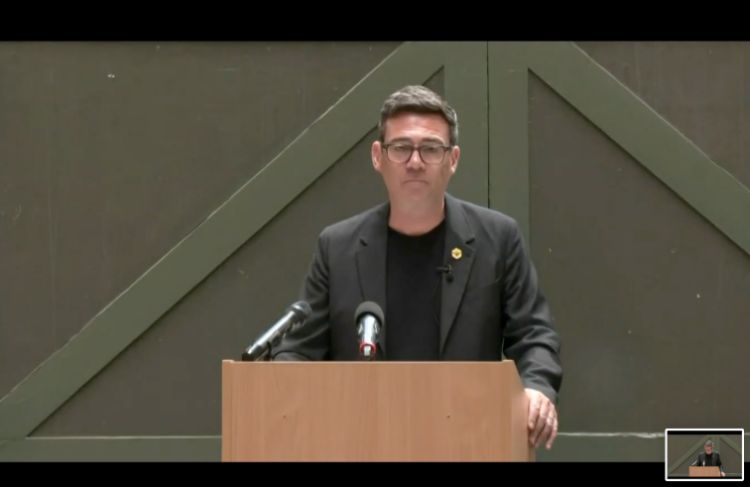
The speech is usually accompanied by words like local empowerment, community leadership, decision-making closer to the people, and other phrases that sound wonderful because nobody can honestly be against them.
After all, who knows what's best for Bolton better than Bolton?
Who knows what's best for Birmingham better than Birmingham?
Who knows what's best for Swindon better than… actually let's not get into Swindon.
The theory is simple.
People in London are detached from reality.
They sit in large buildings making decisions about places they've only ever visited because their train was delayed there.
Therefore, we should give more power to local leaders.
This makes perfect sense.
For approximately eighteen months.
Then somebody local decides to spend £14 million on a sculpture representing "the shared emotional journey of regional resilience" that looks like a bent shopping trolley.
Or launches a digital transformation programme that accidentally deletes half the parking permits.
Or creates a strategic framework for integrated stakeholder engagement that costs £8 million and turns out to be a PDF.
At which point everyone suddenly remembers why the centre was involved in the first place.
There is outrage.
There are inquiries.
There are strongly worded reports.
A minister appears on television and says:
"It is clear that stronger oversight is required."
Power is then pulled back to Westminster.
The centre is back in charge.
Order has been restored.
This also works brilliantly.
For approximately eighteen months.
Then Whitehall discovers that running hundreds of local services from the middle of London is a bit like trying to steer a canoe from another postcode.
Things slow down.
Decision making becomes impossible.
Nobody can replace a park bench without filling in fourteen forms and consulting three departments.
Local leaders begin giving speeches about how disconnected Westminster has become.
Which is technically true because Westminster has spent the previous two years creating a committee to investigate why nobody can replace a park bench.
The solution, naturally, is to devolve power.
And so the cycle begins again.
I call this The Push-Pull of Government Running Things Really Badly.
It works like a pendulum, except instead of measuring time, it measures disappointment.
The funny thing is that both sides are right.
The centre is terrible at running everything.
Local government is terrible at running everything.
The disagreement is simply over which terrible thing should be allowed to run this particular thing.
Eventually voters conclude that neither side has the faintest idea what they're doing.
This is where Reform enters the story.
Reform's current appeal is based largely on the proposition that everyone currently running things is incompetent.
Many voters look around and think:
"Well, that's obviously true."
Which is fair enough.
The interesting question is what happens if Reform actually gets to run things.
History suggests the answer is surprisingly predictable.
People will discover that Reform is also made up of human beings.
Human beings will make mistakes.
Some of those mistakes will be large enough to be visible from space.
Commentators will express shock.
Voters will become disappointed.
New politicians will emerge promising to fix the mess created by the previous politicians.
And then, with the inevitability of a British rail replacement bus service, the whole thing will start again.
Perhaps this is the lesson we keep refusing to learn.
The problem isn't centralisation.
The problem isn't decentralisation.
The problem is that every level of government is staffed entirely by people.
And people, while often well meaning, have a remarkable ability to transform simple problems into expensive reports.
So yes, let's devolve power.
Then let's recentralise it.
Then let's devolve it again.
Then let's vote for somebody completely different.
Then let's discover they're exactly the same species as everyone else.
The wheel will keep turning.
The speeches will keep being given.
And somewhere, right now, a consultant is already preparing a presentation entitled:
"A New Framework For Sustainable Local Empowerment."
Which is how you know the next cycle has already begun.
Leave a Reply