
There’s an assumption baked into WordPress:
That humans are the ones doing the building.
Blocks exist because we needed a way to visually assemble pages.
Drag this. Stack that. Tweak spacing. Nudge things until it looks right.
It’s a design abstraction for human brains.
But what happens when the thing doing the building… isn’t human?
Blocks Were Never About Structure
Blocks feel structured.
They have names. Boundaries. Settings panels.
But under the surface, they’re not really structure in the way machines like structure.
They’re closer to visual components than semantic meaning.
A “Group” block doesn’t tell you what the content is.
A “Columns” block doesn’t tell you why it exists.
Even a “Heading” is often just presentation, not hierarchy you can reliably reason about.
For humans, that’s fine.
For AI, it’s friction.
AI Doesn’t Need Lego Bricks
If you give an AI access to your site today, what does it see?
A tree of blocks.
Nested containers.
Styling decisions mixed in with content.
It has to reverse engineer intent.
It has to guess:
- what’s important
- what’s reusable
- what’s content vs layout
That’s a lot of cognitive overhead for something that’s supposed to be good at reasoning.
Blocks are a UI convenience layer.
For AI, they’re noise.
We’ve Seen This Before
This isn’t new.
In the days of SGML and later XML, content wasn’t stored as “things that look right”.
It was stored as “things that mean something”.
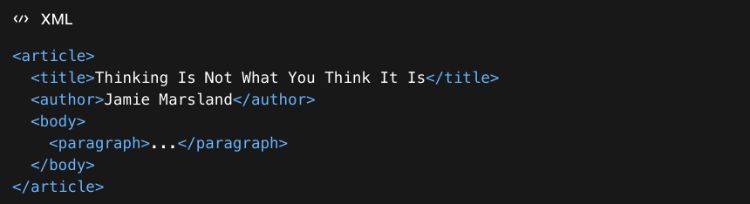
The structure wasn’t visual.
It was semantic.
You could transform it into anything:
- a web page
- a PDF
- a feed
- something that didn’t even exist yet
The design came later.
WordPress Quietly Moved Away From This
Classic WordPress, for all its quirks, had a kind of accidental clarity:
- Content lived in posts and pages
- Design lived in themes
It wasn’t perfect, but it was understandable.
Blocks blurred that line.
Now content, layout, and design all live in the same place.
Which is powerful for humans…
…but messy for machines.
AI Changes the Equation
If AI can:
- design your layout
- choose typography
- generate imagery
- adapt for different devices
Then the value shifts.
The hard part is no longer arranging pixels.
The hard part is understanding meaning.
So What Does the Editor Become?
If blocks aren’t the right abstraction anymore… what is?
Not a blank canvas.
Not a visual builder.
Something closer to a structured content interface.
1. Content organised by meaning
Instead of blocks, you define:
- Article
- Product
- Event
- Landing Page
Each with explicit fields:
- title
- summary
- body
- author
- call_to_action
Not because it’s rigid.
Because it’s understandable.
To humans.
And to AI.
2. Meaning over layout
You’re not saying:
“Put this text in two columns with 40px padding”
You’re saying:
- “This is a testimonial”
- “This is a feature list”
- “This is the primary message”
The AI decides how that should look.
3. Layout as a derived layer
Design becomes a function.
The layout shouldn’t be manually built.
It should be shaped by what the content is trying to do.
Not something you manually assemble.
Something that’s generated, adapted, and continuously improved.
4. Editors become conversations
Instead of dragging blocks, you might:
- describe what you want
- refine meaning
- adjust intent
The editor becomes closer to:
- a brief
- a spec
- a conversation
Than a canvas.
Has Anyone Done This?
Yes, in pieces.
Tools like Contentful and Sanity already lean heavily into structured content.
They treat content as data first, presentation second.
But they’re still built for humans to model systems manually.
What’s missing is:
An AI-native layer that:
- understands that structure automatically
- adapts it dynamically
- removes the need to predefine everything upfront
A Different Mental Model
Maybe the future WordPress editor isn’t:
- block-based
- page-based
- even “site editing” as we know it
Maybe it’s:
A structured content system, with clear meaning built in, and AI handling how it gets presented.
Pages don’t disappear.
They become views.
The Slightly Uncomfortable Bit
If this direction is right, then blocks aren’t the end state.
They’re a transition.
A bridge between:
- raw HTML
- and fully structured, AI-native content systems
Which raises a bigger question:
Is WordPress a website builder…
or is it becoming a content operating system?
Where This Gets Interesting
Because if WordPress leans into this:
- MCP/CLI’s become far more powerful
- AI agents don’t have to “interpret” your site
- content becomes portable, reusable, remixable
And suddenly, WordPress isn’t competing with visual builders.
It’s competing at a completely different layer.

Leave a Reply to Jeffrey Zeldman Cancel reply