
I recently bought an analogue synthesizer, specifically a Korg Monologue, which is a sentence that makes me sound much cooler and more musically competent than I actually am.
I bought it because I have a band called Shenanigans, and I have decided, entirely on my own and without informing the other members, that we are now the kind of band that uses analogue synthesizers. More specifically, we are now the kind of band that has a slightly moody, atmospheric Portishead vibe.
This decision has been made without consultation, evidence, or any indication that the band wants a Portishead vibe. At present, they believe they are still in the same band they were in last month.
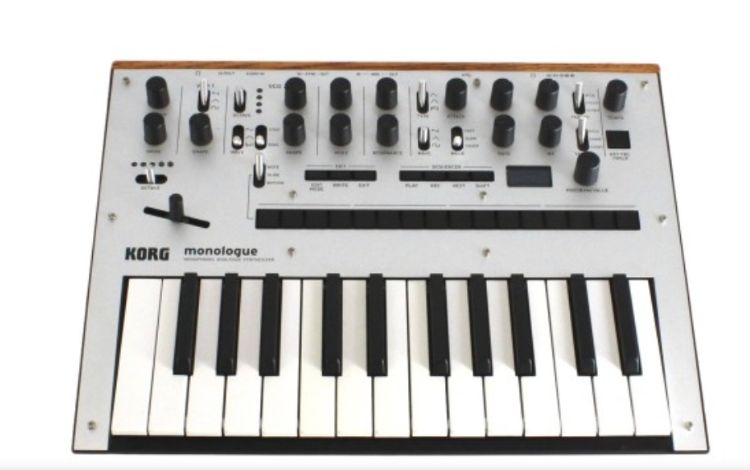
At the moment, I am sitting alone in a small room with the Korg Monologue, producing noises that sound less like Portishead and more like a depressed fax machine going through a difficult divorce.
I bought the synth because I had a vision. In my vision, I was effortlessly creating rich, cinematic soundscapes while nodding thoughtfully, like a Scandinavian person in a documentary. Instead, I was staring at a panel containing approximately 7,000 knobs, each labelled with a word designed to make you feel stupid. Oscillator. Envelope. Subtractive filter. LFO. At one point I am fairly sure one of the knobs was labelled Personal Failure.
Now, in theory, an oscillator produces a waveform, which is then shaped by an envelope, then filtered, then modulated, and then somehow becomes music.
In practice, what happens is you turn a knob and the synth goes
WAAAAAAAUUUUUUURGH
which is not so much music as it is the sound of a robot discovering tax.
I did what any reasonable person would do. I watched YouTube tutorials. These tutorials are made by calm, bearded men who say things like, Here I’m just slightly adjusting the attack, and then they gently move a knob one millimetre. Their synth produces the most beautiful sound you have ever heard.
When I adjust the attack, my synth produces the sound of a dishwasher falling down the stairs.
I learned about sine waves, square waves, sawtooth waves, and triangle waves. I learned about harmonics, resonance, and modulation. I learned so much that if you asked me to explain it, I would confidently reply
Yes.
But despite all this knowledge, I still couldn’t make a sound I actually wanted.
This is the dirty secret of analogue synths. They are not instruments. They are confidence tests.
Eventually, after several months of this, I reached what experts call Knob Despair, where you turn knobs randomly, hoping to accidentally invent Portishead, but instead invent Plumbing Emergency.
So I did what humans have always done when faced with a tool they don’t understand.
I cheated.
I turned to AI.
At first, I asked it to teach me. I described the sound I wanted. It explained envelopes again. It explained filters again. It explained oscillators again.
This was very helpful in the same way that explaining gravity is helpful when you fall off a roof.
So I did something else.
I built a small app.
The app sits between me and the synth. It talks to the synth. It’s a translator. I can describe what I want in human terms, like make it sound like a sad robot in space, and it adjusts the oscillators, shapes the envelope, and moves the filter.
Suddenly, the synth makes the sound I was imagining.
This was incredible, not because the AI was creative, but because it removed the friction between my imagination and reality. It turned the synth from a machine into a collaborator. It became a creative layer on top of the tool.
And here is the strange thing.
By using this layer, I started to learn.
Because now, when the AI made a sound, I could see what it did. I could see which oscillator it used, how it shaped the envelope, and how it adjusted the filter.
Slowly, the fog started to lift.
Not intellectually.
But practically.
I started making small adjustments myself. Tiny ones at first, then bigger ones.
Until one day, I realised something slightly alarming.
I wasn’t using the AI anymore.
Not because I didn’t need it.
But because I didn’t want it.
I wanted the knobs.
This, I think, is the part of AI people misunderstand.
They think it replaces learning.
But sometimes it does the opposite.
Sometimes it makes learning possible.
It gives you a bridge, and once you cross the bridge, you don’t need it anymore.
It’s like training wheels, or subtitles, or that friend who explains cricket.
Eventually, you see it yourself.
The deeper thing here isn’t about synths. It’s about tools.
For most of history, tools have required humans to learn their language.
AI is the first tool that learns ours.
It sits on top.
It translates intention into action.
It turns
I don’t know how
into
I can.
And once you can, you begin to understand.
And once you understand, you begin to create.
And once you create, you become the thing you were trying to be all along.
In my case, this means Shenanigans may soon become a moody, atmospheric Portishead inspired band.
Now I just need to tell them.
Leave a Reply