
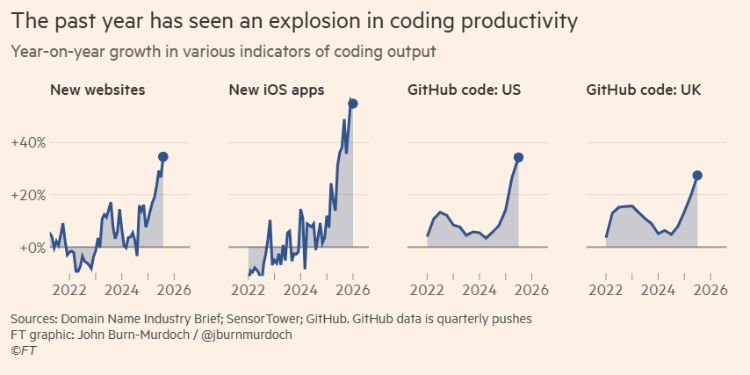
That FT chart was doing the rounds last week. New websites up 35%. New iOS apps up nearly 50%. GitHub code output surging.
I work at Automattic, parent company of WordPress.com. So when I saw it, I dug into the source data. The FT chart shows the explosion. It doesn’t show who’s behind it.
The surge is real. But it’s going somewhere specific.
The FT sourced its website data from the Domain Name Industry Brief — Verisign’s quarterly report on global domain registrations. Q4 2025: 386.9 million registered domains worldwide, up 6.2% year on year. New generic TLDs .ai, .io, .app grew at nearly 30%. Three times faster than .com.
Something genuinely changed in 2024-25. The question is who captured it.
WordPress didn’t ride wave one. I think that’s just true.
The first wave was taken almost entirely by tools most people outside tech hadn’t heard of eighteen months ago. Lovable. Bolt.new. Replit Agent. Vercel v0.
These are not website builders in the traditional sense. They produce full-stack apps, deployable products from a prompt. No templates, no themes, no plugin decisions. You describe what you want. You get a URL.
The numbers are striking. Lovable went from zero to $100M ARR in eight months — the fastest in software history, faster than OpenAI, faster than Cursor. It hit $200M ARR by the end of 2025. Bolt.new launched with a single tweet in October 2024 and hit $40M ARR within months. Replit went from $10M to $100M ARR in around six months after launching Replit Agent, and hit $253M ARR by October 2025.
This is where the new-site surge is actually coming from.
Why wave two is WordPress’s to win.
Two things have changed that matter.
The first is the models. The gap between what an AI can produce for a Lovable-style prompt versus a WordPress-native experience has closed dramatically. When generation quality is roughly equivalent, what differentiates the result is what sits underneath it — and nothing in the world has a more mature, more extensible, more battle-tested foundation than WordPress. 60,000 plugins. WooCommerce. A hosting ecosystem built around it. Fifteen years of stability.
The second is the AI work happening inside WordPress itself. The direction is toward something closer to what the winning platforms are doing — where AI is the experience, not a layer on top of it. That’s a harder architectural shift than it sounds. But it’s the right one.
The thing the numbers can’t show you.
Lovable has 2.3 million active users. Bolt has 5 million signups. Impressive. WordPress has 43% of the entire web.
That’s not a boast. It’s actually a constraint — in some ways the weight of backward compatibility, the diversity of users, the complexity of what WordPress has to be for so many different people. But it’s also the most extraordinary distribution advantage in the history of software platforms.
Wave one was won by speed. Small teams, zero legacy, clean AI-native architecture. They deserved to win it.
Wave two will be won by trust, depth, and reach. A platform that a billion sites already run on, that developers already build on, that businesses already depend on.
I saw the FT chart and thought: that’s the story of what we missed.
The more I dug into it, the more I think it’s the story of what’s coming.
Sources
- Verisign Domain Name Industry Brief Q4 2025 — domain registration figures, .ai/.io/.app growth: https://www.verisign.com/en_US/domain-names/dnib/index.xhtml
- TechCrunch, Nov 2025 — Lovable hits $200M ARR: https://techcrunch.com/2025/11/13/lovable-hits-200m-arr/
- TechCrunch, Jan 2025 — Bolt.new reaches $40M ARR: https://techcrunch.com/2025/01/15/bolt-new-reaches-40m-arr/
- Sacra research — Replit $253M ARR (Oct 2025): https://sacra.com/research/replit-arr/
- Sacra research — Vercel $200M ARR: https://sacra.com/research/vercel/
- W3Techs — WordPress CMS market share (43%): https://w3techs.com/technologies/details/cm-wordpress
Leave a Reply