
Yesterday I watched a WordPress plugin bounce between creators like it was competing in some kind of WordPress relay race. Idea, prototype, remix, accessibility audit, polished final version. All in a day. It felt like a preview of a future where collaboration is effortless and AI tools turbocharge the whole process.
It began when I was browsing Stripe Press at https://press.stripe.com
, which happens to be a WordPress site. I noticed the most beautiful smooth scrolling page navigation known to humankind. It glided. It floated. It behaved like a polite ghost gently guiding you through the page. My brain immediately said the only reasonable thing which was, I want something like this on my website.
So I tried to recreate it. I built a first version using WordPress Studio and Cursor. It actually worked. I felt like a proud parent watching a child take its first slightly wobbly steps. I posted the result on LinkedIn.
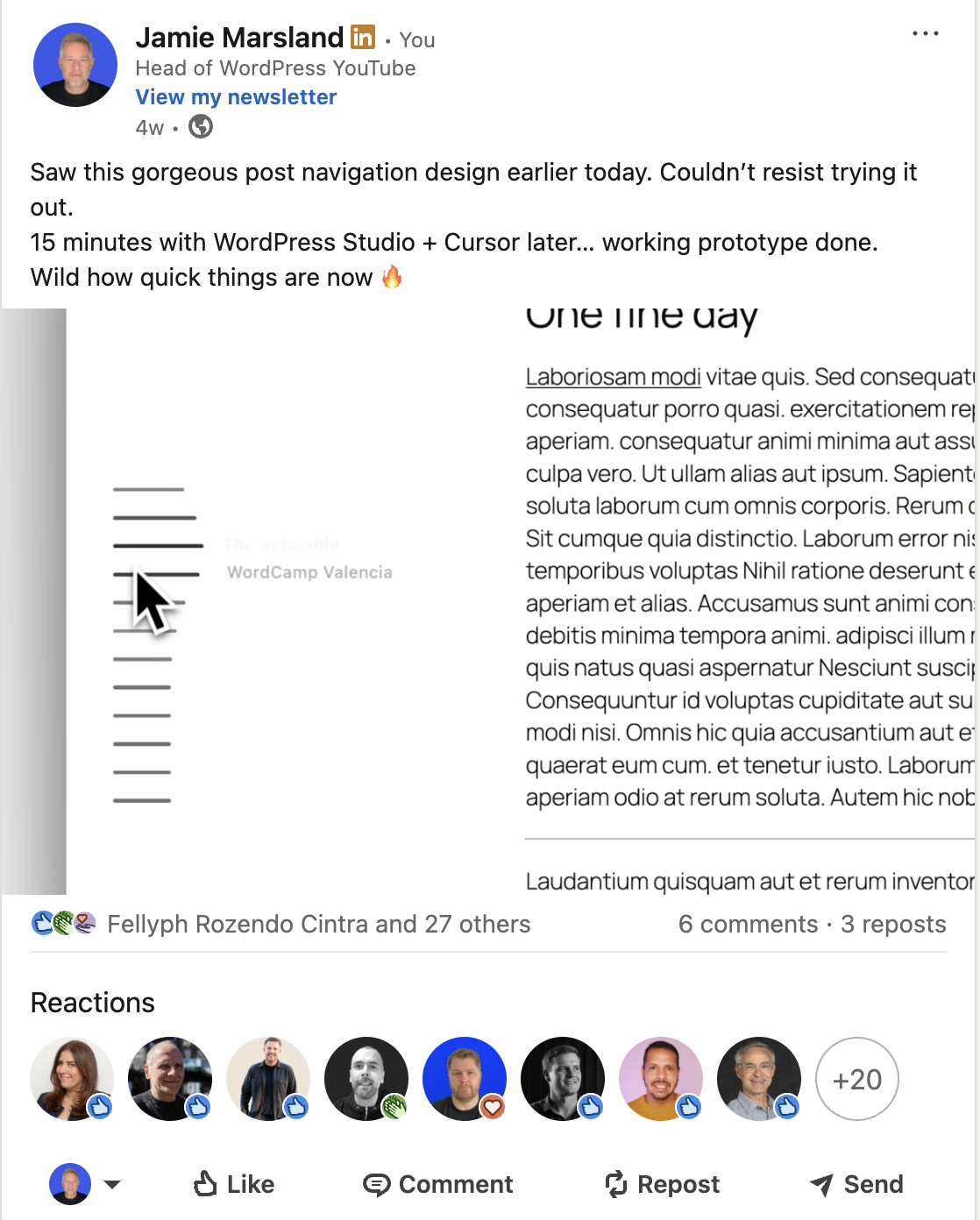
The response was great. People were into it. Lots of encouragement, plenty of interest, and a general sense of yes, more of this please.
Then things took a turn I did not expect at all.
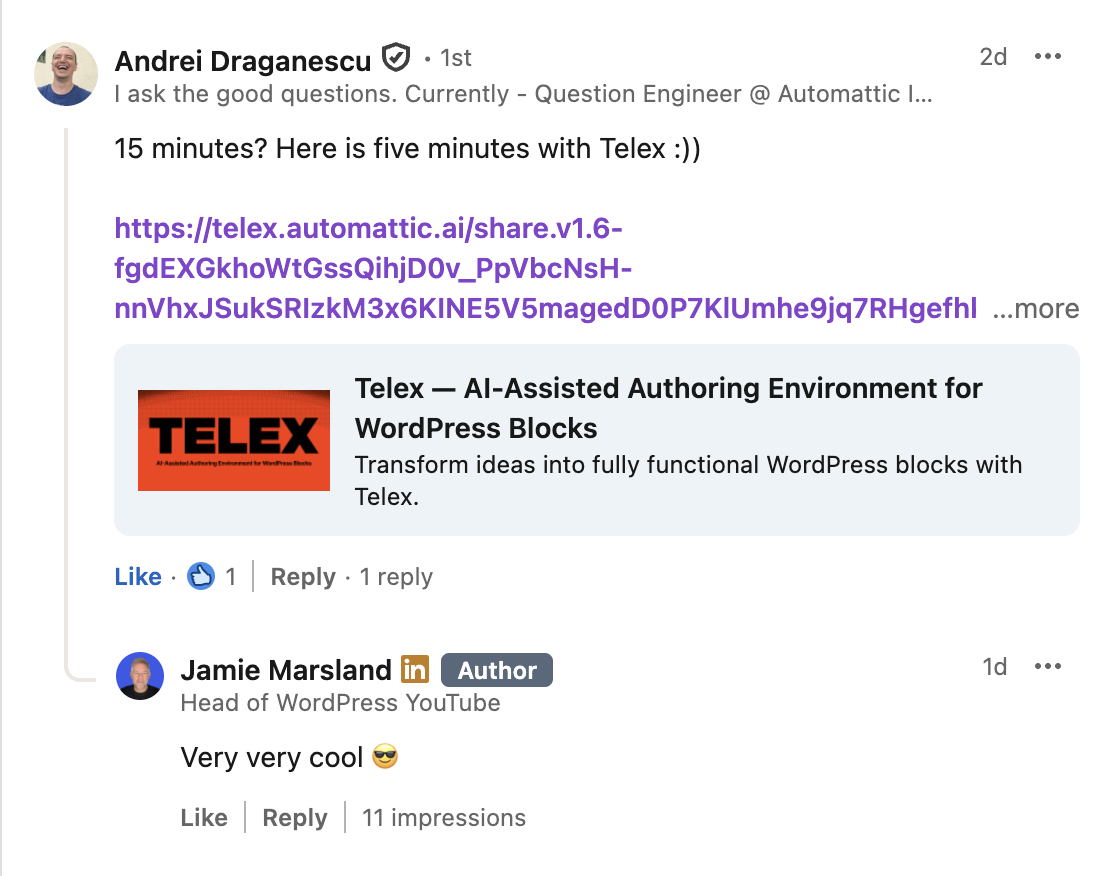
Andrei Draganescu (Automattic) saw the post. Andrei is one of the lead developers of Telex, which explains why he appears to operate at a creative frequency the rest of us cannot detect. He grabbed my version, ran the whole thing through Telex AI, and rebuilt it in about five minutes. He then casually shared his version, which looked fantastic and made my original look like it had eaten too many carbohydrates.
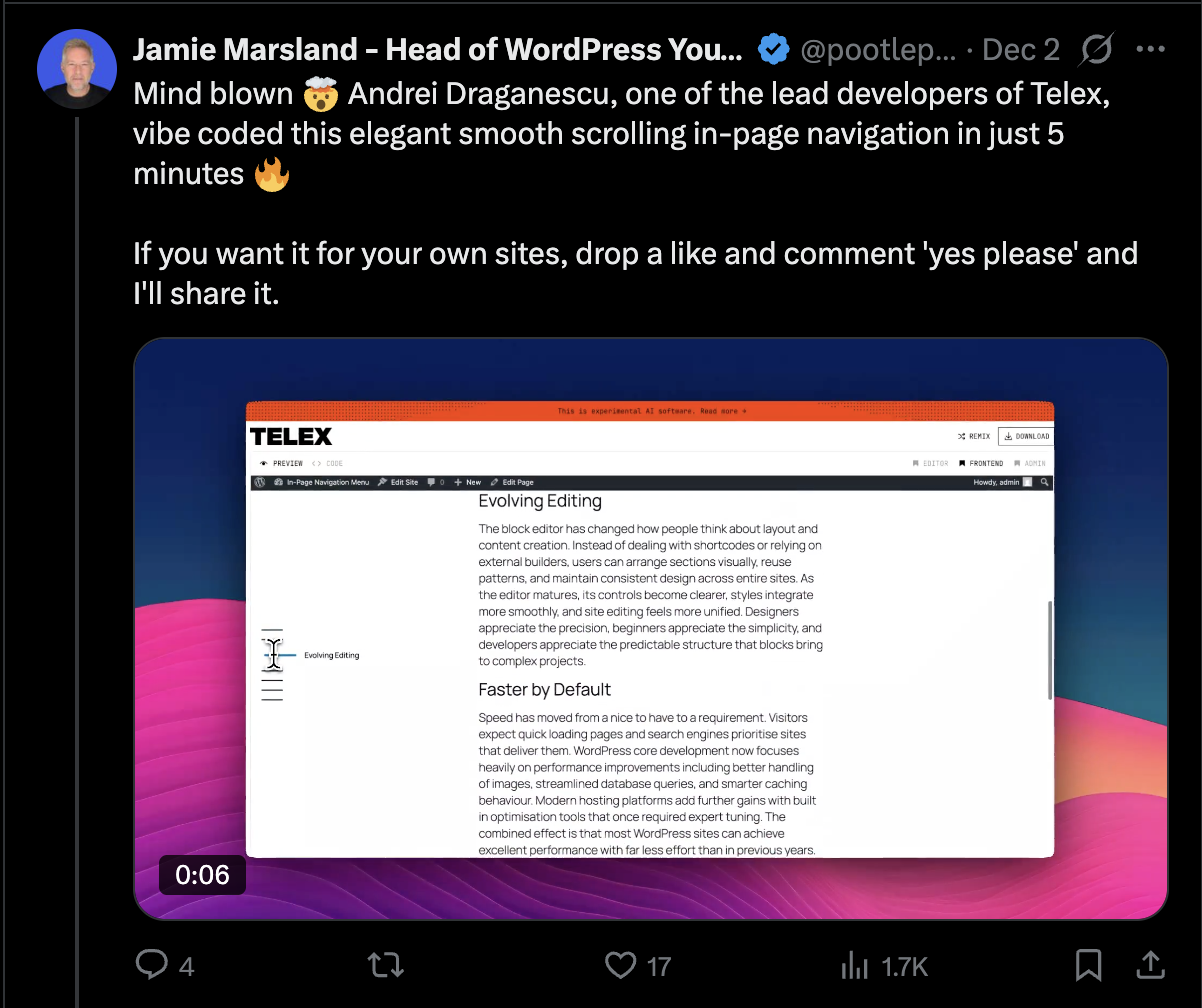
I shared Andrei’s remix on X. This turned out to be the moment when everything shifted from fast to educational.
Amber Hinds (Equalize Digital) appeared. Amber has the uncanny ability to detect accessibility issues the way dolphins detect sonar pings. She explained, very kindly, that while the plugin looked lovely, it was constructed entirely from divs and spans. Keyboard users would struggle. Mobile users would squint. People who zoom in would watch the entire thing vanish. There were no proper headings. No lists. No focusable links. No visible focus states. No navigation element. In other words, it was decorative rather than functional.
She also offered a crystal clear list of how proper semantics should work. Headings with purpose. Ordered lists for structure. Links that real humans can select. Focus indicators that do not require psychic ability. A navigation wrapper. aria-current styling. Everything explained in a way that even someone hopelessly lost in CSS land could understand.

This is where vibe coding reveals both its charm and its blind spots. AI can create something beautiful. It cannot always create something usable.
Then Steve Jones (Equalize Digital) entered the conversation. Steve and has enough accessibility knowledge to qualify as a human validator. He pointed out that although Andrei’s Telex remix was impressive, making it fully accessible required a deeper rebuild.

He took on the challenge, remixed it with proper semantics, improved behaviour for keyboard and screen reader users, and turned it into something genuinely robust. Amber added feedback. Steve refined it. The two of them carefully assembled the correct structure while the rest of us watched in admiration.
Here is the really incredible part. All of this happened in less than a day. The inspiration came from Stripe Press. The first version came from me. The Telex powered remix came from Andrei. The accessibility audit came from Amber. The refined, best practice compliant version came from Steve. Different people. Different strengths. Different tools. Everything unfolding faster than a pot of pasta water reaching a boil.
Open source has always been collaborative. That part is not new. What is new is the speed. With tools like WordPress Studio, Cursor, and Telex AI, the gap between idea and execution has shrunk to almost nothing. You do not need a weekend to prototype. You do not need to write every line by hand. You try something, see a version instantly, and then let experts help shape it. Creativity, correction, and improvement blend together almost in real time.
This is the beginning of a remix era in WordPress. Not the musical kind, though that would also be fun. A remix era where ideas bounce between people at conversational pace.
Imagine remix challenges. Tag team plugin builds. Community remix days. Shared vibe coded starting points that anyone can extend. Creativity becomes social because AI removes so much of the slow manual work.
It fits perfectly with the idea of remixable software I wrote about earlier. You start with something real. You adapt it. You reshape it. You make it your own. The cycle moves fast enough to feel playful.
Yesterday felt like a preview of that future. A future where development is collaborative, quick, and surprisingly fun. A future where someone posts an idea at lunch and by dinner three people have rebuilt it, two have improved the accessibility, and one has restructured the whole thing into a model example of how plugins should behave.
Something unique happened in WordPress yesterday and it was incredible to watch in real time. If you want to explore what comes next, here is the link to remix the project yourself and keep the chain going.

Leave a Reply to WP Weekly 272 – Winners – WP Awards, Monitor Plugin Stats, WP 6.9 Updates Cancel reply