
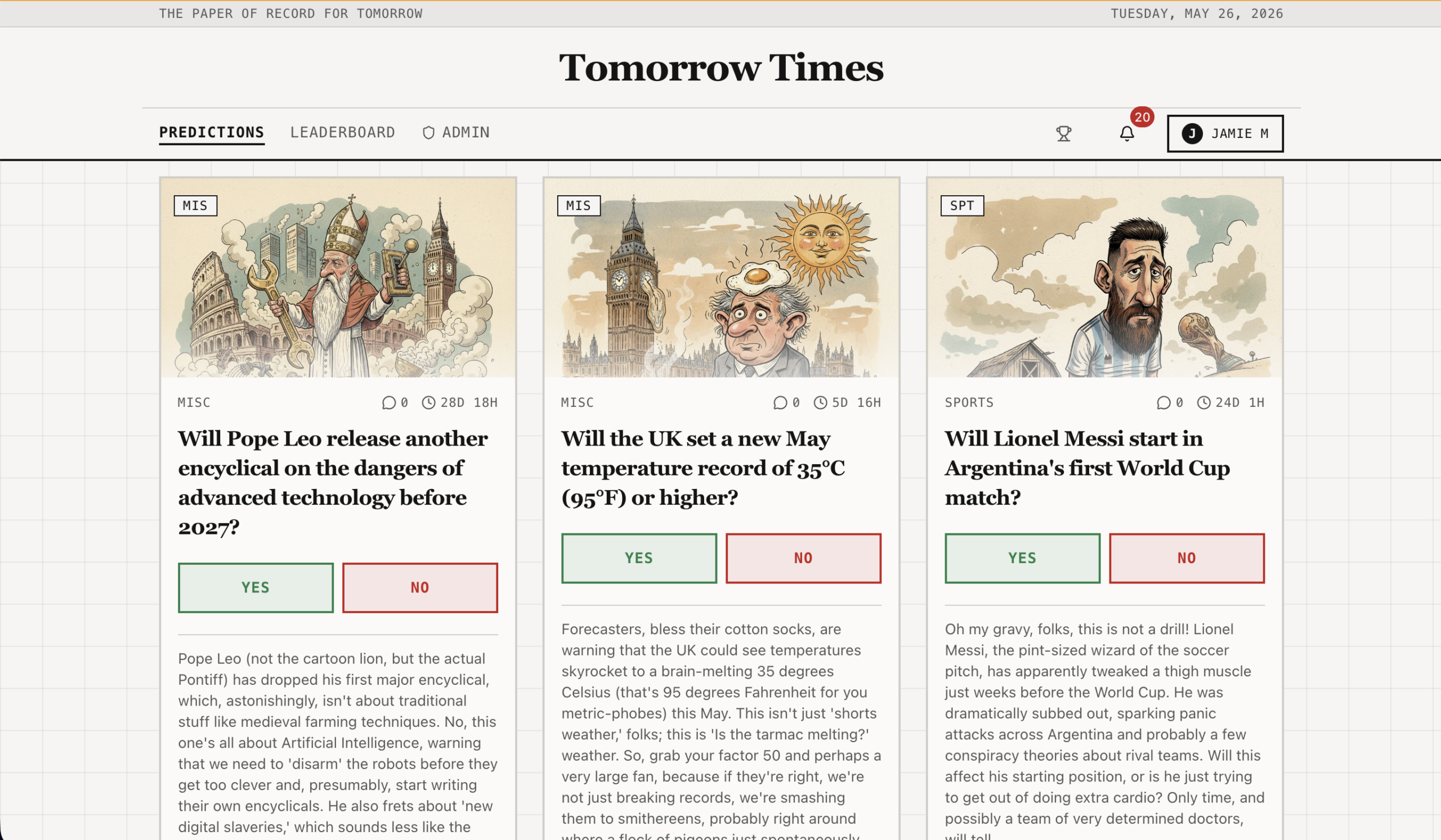
Every morning at 8am, Telegram sends me five draft prediction cards for Tomorrow Times.
I didn’t pick the stories.
I didn’t write the questions.
I didn’t commission the illustrations.
AI agents did it while I slept.
While I’m asleep, a small invisible newsroom is quietly working in the background. One agent scans the news. Another decides what matters. Another watches for breaking stories. Another resolves predictions. Another handles social posting.
Increasingly, Tomorrow Times feels less like a website I run and more like a newsroom I supervise.
1. The story scout AI agent (import-stories)
Every 15 minutes, this agent polls RSS feeds from configured sources including BBC, Reuters, ESPN, tech blogs, and political outlets.
It:
- Strips messy HTML
- Removes duplicates
- Checks what is already in the database
- Runs a lightweight AI summariser to turn raw RSS snippets into readable context
By morning, 20 to 40 stories are sitting in the queue.
I never see most of them.
2. The morning editor AI agent (daily-digest)
At 7am, this agent wakes up.
It pulls the 40 most recent stories and sends them to an LLM with a simple brief:
Pick the 5 most viral, water-cooler-worthy, resolvable stories. Mix categories. Close dates 7 to 30 days out.
The result is five prediction cards, each with:
- A title
- A yes/no or multiple-choice question
- A satirical TL;DR
- A category
- A close date
Then it:
- Generates a satirical editorial illustration
- Uploads the image to storage
- Saves everything as draft cards
- Sends them to Telegram with one-tap Publish / Delete buttons
At 8am, those five cards arrive on my phone.
The AI has already done the sorting for me.
I mostly make the final call.
3. The breaking news watchdog AI agent (breaking-news)
Every hour, this agent checks for genuinely major stories from the last 90 minutes.
Political shocks. Market-moving events. Sports upsets. Celebrity bombshells.
Its instruction is intentionally strict:
Silence is correct 95% of the time.
When it fires, it drafts at most one card and sends it to Telegram with a 🚨 Breaking header.
Most hours, it does nothing.
That is by design.
4. The resolution detective AI agent (resolution-checker)
Once an hour, this agent checks prediction cards whose close_at date has passed.
For each overdue card it:
- Searches the web using Firecrawl
- Pulls together evidence
- Asks an LLM:
What actually happened? Pick from these exact options.
Then Telegram sends me:
- A proposed answer
- Confidence level (🟢 / 🟡 / 🔴)
- Confirm
- Override
- Extend by 7 days
- Close with no winner
Predictions are only useful if someone eventually asks:
“Did the thing actually happen?”
5. The social media poster AI agent (social-poster)
When I tap Publish, this agent springs into action.
It:
- Writes a short satirical social hook
- Posts the card and image to X
- Records everything in a
social_poststable - DMs me the result
6. The player email AI agent (email-agent)
Tomorrow Times has players.
Sometimes I need to email them.
So I built an email agent that works entirely through Telegram.
I can send a message like:
Email all players about tomorrow’s prediction deadline
Or:
Email everyone who has not made a prediction this week
The agent:
- Understands the request
- Finds the right players
- Drafts the email
- Sends it via Resend
- Confirms what happened back in Telegram
No opening an email app.
No exporting a list.
No copy and paste.
Increasingly, Telegram is becoming the control room for Tomorrow Times.
Satire meets political cartooning
Tomorrow Times has developed a house style.
Every piece of text, from prediction summaries to social posts, follows the same tone: witty, playful, slightly absurd, built for the strange theatre of modern news.
The artwork borrows heavily from British political cartooning traditions.
Messy ink. Watercolour washes. Slight chaos.
The result feels less like automation and more like a tiny satirical newsroom powered by cron jobs and LLM prompts.
What I actually do
AI is not replacing me.
It is changing my role.
The agents do the legwork:
- Finding stories
- Drafting prediction questions
- Generating illustrations
- Researching outcomes
- Posting to social
- Emailing players
Then they hand me a clean decision:
Publish. Delete. Resolve.
I spend less time typing.
Far more time judging.
Because when AI removes the busywork, what is left is taste.
Judgment.
Editorial instinct.
What happens next?
Building Tomorrow Times this way has me wondering what else could work like this.
The obvious next step feels like ecommerce.
Not another chatbot floating awkwardly in the corner of a website pretending to help.
Something more useful.
Imagine an AI store operator quietly working in the background:
Watching inventory.
Spotting slow-moving products.
Writing product copy.
Suggesting promotions.
Following up abandoned carts.
Helping customers.
Keeping the shop moving while the owner sleeps.
The invisible newsroom might turn out to be the first draft of something much bigger.
PS: Tomorrow Times is currently in beta. Still early, still experimental, and very much a work in progress.
Comments
2 responses to “The Invisible Newsroom: How AI Agents Are Starting to Run TomorrowTimes.com While I Sleep”
[…] few folks asked me how Tomorrow Times agents work, so here are the […]
[…] to use AI Agents for starting a newsroom website, by […]