
Fifteen years ago, I had an idea. When you watch the news or read a story, the unspoken question is almost always the same: what happens next?
What if there was a place where you could make quick predictions on the news and see how good you really are at forecasting the future? Back then, building something like this would have required a team of engineers, expensive infrastructure, and months of work just to get the basics right.
This weekend, I finally built it.
It’s called Tomorrow Times, and it’s a small, fun side project I put together in a single weekend.
The Idea
Tomorrow Times is a lightweight prediction game with a newspaper-style interface. Users make predictions on news and sports events, earn points when they’re right, and see how they stack up on a leaderboard. It’s not meant to be overly serious. It’s a playful way to engage with the news and test your instincts.
What made it possible to build so quickly is how much of the heavy lifting is handled by AI.
The Architecture: RSS + AI = Minimal Effort Content
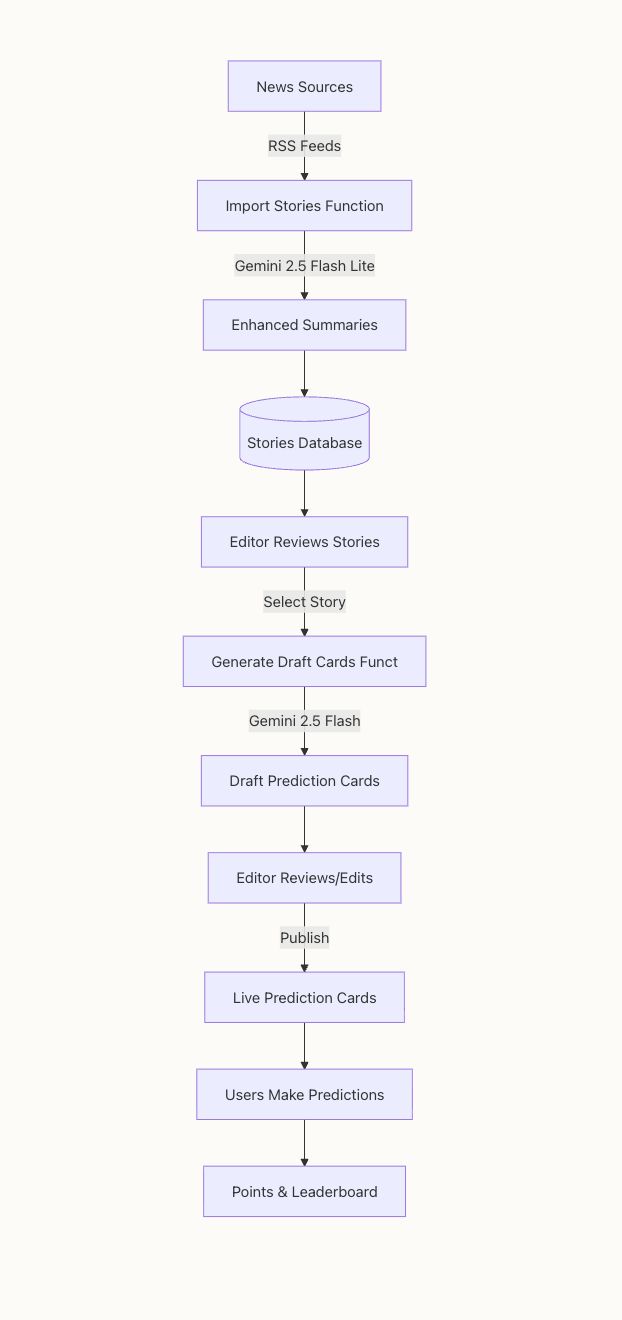
Here’s the rough flow:
RSS Import
Stories are pulled from selected news sources via RSS feeds. An edge function fetches the feed, extracts the useful bits, and ignores duplicates.
AI Summaries
RSS descriptions are often messy. Each story is passed through Google Gemini 2.5 Flash Lite to generate a short, readable summary that gives enough context to make a prediction.
Prediction Generation
When a story looks suitable, it’s sent to Google Gemini 2.5 Flash, which generates:
A concise prediction question
A handful of answer options
A sensible closing time
Everything lands as a draft so nothing goes live without a quick human check.
The Stack
The whole thing is deliberately simple:
React + TypeScript
Tailwind CSS for the newspaper feel
Supabase for data, auth, and edge functions
Lovable AI for model access, using Google’s Gemini 2.5 models
No servers to manage. No complex pipelines. Just enough structure to make the idea work.
The Point
Fifteen years ago, this idea would have stayed a notebook sketch. Last weekend, it became a working app.
Not because the idea changed, but because the cost of turning ideas into software has collapsed. AI handles the boring parts, scaffolding, glue code, and first drafts, so you can focus on whether something is actually fun.
Tomorrow Times isn’t a startup. It’s not a product roadmap. It’s a reminder that building for curiosity and enjoyment is easier than it has ever been.
Tomorrow Times is a weekend side project and is still very much in development at tomorrowtimes.com
Leave a Reply